George Orfanakis / University / Biomedical Technology
REC CH1 · surface EMG · 1000 Hz AUTh ECE · semester 7 · 2026–27
EMG Monitor Βιοϊατρική Τεχνολογία · Biomedical Technology · a team project
A portable surface-EMG sensor and the Android app that reads it. Electrodes on a muscle feed an amplifier, an ESP32 streams the signal over Bluetooth LE, and the phone counts every contraction live and keeps a log of each session.
- App 0.5.0 · firmware 0.2.1
- Live demo · January 2027
- Team of three
- AUTh ECE
01 / How it works
From a muscle to a CSV file
Electrodes pick up the tiny voltage a muscle makes when it contracts. A front-end amplifies and band-passes it; the ESP32 samples it 1000 times a second and sends it to the phone in small packets.
02 / Detection
Counting a contraction
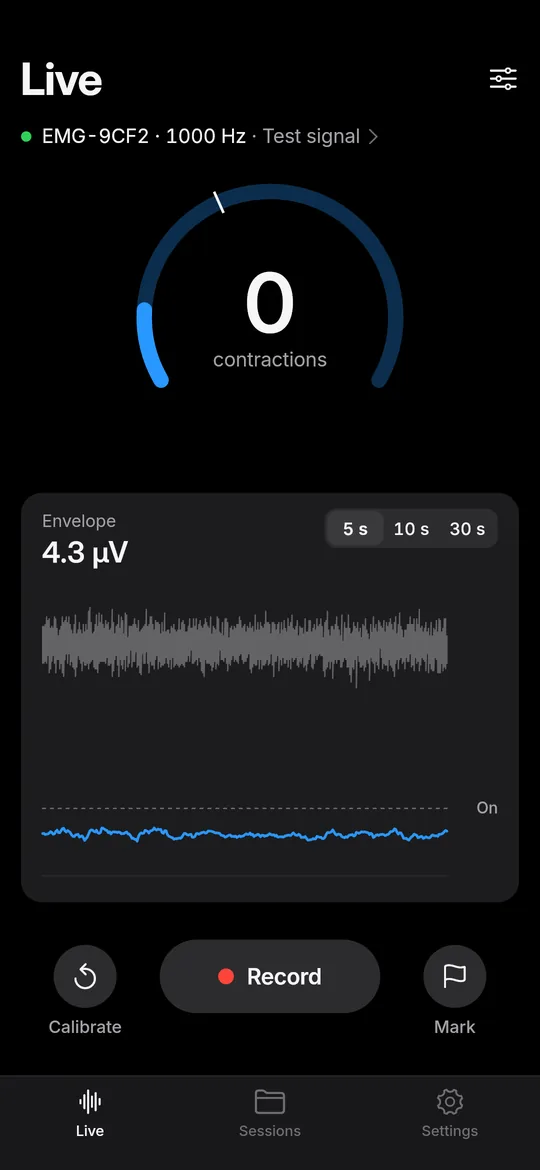
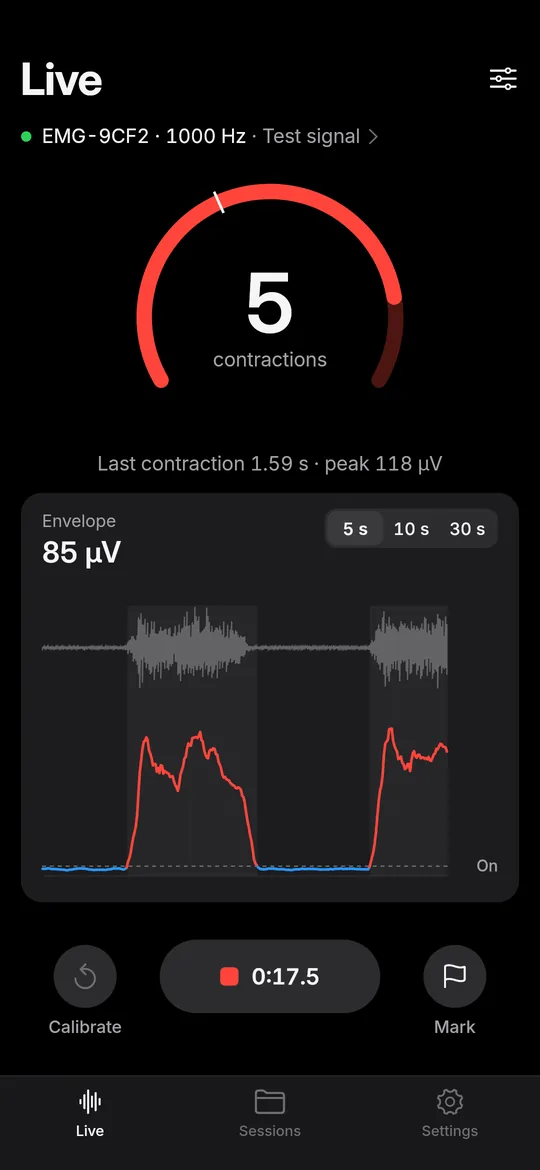
Before each session the app records a few seconds of the muscle at rest and measures the noise floor. A contraction starts when the RMS envelope rises above a threshold set from that rest recording, and ends only when it falls back below a lower level, so a single noisy spike can't count twice.
The same detector runs in the app (Dart) and in the analysis code (Python), and both are checked against shared test vectors, so the phone and the PC agree on every count.
Ton = μ₀ + h · max(σ₀, 1 µV)
Also in the app
- Live signal and RMS envelope at the display's frame rate
- Sessions with muscle and side, markers by holding a button
- CSV export with units, settings and calibration in the header
- A firmware test signal to check the whole chain without electrodes
- A clipping flag on every packet
- Light and dark, English and Greek
03 / Screens
The app, version 0.5.0


04 / Team
Three students, one sensor
EMG Monitor is a team project by three Electrical & Computer Engineering students at the Aristotle University of Thessaloniki, for the course Biomedical Technology. Together we built the sensor, the firmware, the app and the analysis.
The course approved a ready-made EMG module (DFRobot SEN0240). The board runs on four AA batteries with gel electrodes; next we record real contractions and compare the app's counts with the analysis on a PC. The live demo is planned for January 2027.
Safety. During measurements the board runs on batteries only and is never connected to a mains-powered computer. This is a teaching project, not a medical device.
The code stays private while the course runs.
Back to George's university work